Rogallo Hall of Fame Inductees – Rob & Dianne McKenzie
Rob and Dianne McKenzie Biography
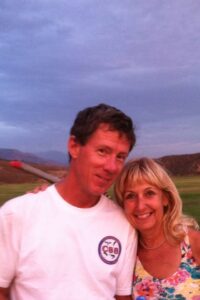
Rob was born in 1955 in Ontario Canada, and Dianne a year later in the Los Angeles area. It would be 25 years before they would meet.
Growing up Rob had an intense interest in things that fly. By age 9 he was building model gliders and placed 2nd in the 1966 Canadian Nationals at age 11. At age 15 he entered the local Science Fair with a wind tunnel he designed and built and tested wing slots and their effect on lift and drag. The entry won a trip to the Canadian National Science Fair in Edmonton. In 1974 he designed and built a hang glider and taught himself to fly. Not having a car he built the hang glider to break down to 6’ length to tow behind his 10 speed bike.
Also in1974 Dianne attended a fly in for hang gliders at Escape Country near Los Angeles which sparked her lifelong interest in hang gliding.
Rob attended Waterloo University studying electrical engineering. But despite good grades, after 2 years he withdrew and moved to Montreal to follow his flying passion. By 1977 he became manager of a local hang gliding shop. Wanting to find a better place to fly he moved to the Los Angeles area in 1979 to work as shop manager at Bill Bennett’s Delta Wing Kites and Gliders. A year later he moved to the Crestline area and onto a newly founded landing area called Pine Crest Air Park in San Bernardino. The flight park was owned by Andy and Juanita Jackson.
Meanwhile Dianne, with her husband, and her daughter moved to San Bernardino in 1976. The marriage was not doing well and they separated by early 1981. By the fall of 1981 Rob and Dianne began a lifelong partnership, raising Dianne’s daughter and building a life related to hang gliding (including paragliding in later years).
They soon found that providing tandem flights as a team was something they were good at that could bring a modest income. Dianne’s outgoing social personality and Rob’s technical demeanor made for a very balanced team so that tandem passengers found both a fun and relaxed atmosphere while also being reassured of the safety aspects.
The US Nationals had been held at Crestline in 1979 where Rob had been launch director. It was obvious that such events created a traffic problem on the narrow roads near launch. Rob mitigated this over the next 2 years by negotiating with the US Forest Service so that the local flying club, Crestline Soaring Society (CSS) could get a permit to build and maintain a paved parking lot. The permit was granted in spring 1982.
In October 1982, the FAA introduced Part 103. It prohibited tandem flying. Rob found a work around by getting his tandem glider registered as an experimental glider and then getting a glider pilot certificate. The check ride was done in the hang glider by taking an FAA examiner for the check ride.
Rob was reluctant to set up a full training school and instead just wanted to provide tandems. He contracted with 3 local hang gliding schools to provide tandems to prep their students for mountain solos.
Rob and Dianne hosted the 1982 hang gliding Nationals in 1982 donating the profits to Pine Crest Air Park. In 1984 they again hosted the US Nationals but this time the profits were donated to the CSS. Rob and Dianne were married in July 1984.
Andy Jackson died of cancer in 1985 leaving Juanita to carry on his dream without a partner. Also that year, Dianne and Rob decided to start providing full hang gliding instruction instead of just tandem training flights for other schools. Their school DBA was filed as “High Adventure”. It would in time become known by many as the “biggest little school” in the US.
In 1986 Rob and Dianne were intrigued by a new and revolutionary truck tow system being developed by Jerry Forburger of Lubbock TX. They purchased a unit that fall. It was then modified to make it more efficient sometimes doing 40 tandem tows to 1500’ in an 8 hour day. An hour’s drive from Pine Crest was a 5 mile long, mile wide dry lake bed that allowed exploring towing while turning and step towing.
By 1987 the CSS had still not required pilots to get tandem rated to fly Crestline even though it had been 5 years since Part 103 started. Rob and Dianne increased pressure on the CSS and local tandem pilots to get their USHGA tandem ratings but this just led to friction among the pilots. Many pilots felt it wasn’t the job of the CSS to enforce laws created by the FAA. Related to this was Joe Greblo asking Rob to join the tandem committee. Reluctantly Rob joined and attended BOD meetings for the next 7 years.
In 1988, Juanita was becoming discouraged by the effort needed and lack of income related to running a hang glider park. At Juanita’s request, Dianne and Rob moved their home based shop into the landing area paying monthly rent which didn’t really benefit their own business but did greatly help with Juanita’s income and therefore her desire to continue the air park.
In 1989 the State of California Department of Water Resources (DWR) announced their intent to build, adjacent to the LZ, a billion dollar hydroelectric power plant and shut down Pine Crest Air Park. Dianne and Rob led a push to lobby support from pilots and local residents. Rob also went over the DWR’s head to the federal government where the licensing for the power plant came from. Subsequently the Federal Energy Regulatory Commision (FERC) in July 1990 required that the DWR relocate the landing field and purchase the original, relieving Juanita of needing to run a hang glider park and giving the authority to run the new park directly to the pilots themselves. Andy’s dream would live on.
The 1990’s were golden years for the new Andy Jackson Airpark. Dianne and Rob became involved with paragliding and began teaching both sports. They could see that in many parts of the country there was growing animosity between the two types of gliding. They led by example to embrace and see the benefits of each wing and spread the love.
In 1999 the 30’ sand dune 10 miles from the LZ, that had been used for hang gliding basic training since 1980 was permanently closed. To replace the loss, Rob rented a tractor and created a 10’ tall 40’ long wedge of dirt directly on the LZ. It wasn’t big enough by itself for launching in the usual light winds, but by enhancing the energy with towing using a 150’ long bungee and creating self releasing hooks on the harnesses plus encouraging Wills Wing to provide a prototype 330 sq ft glider it all worked amazingly well. The success led Wills Wing to introduce their Condor 330 soon thereafter.
In 2000, spring water was found in the hills above the LZ and Rob and Dianne with the help of a few pilots, built a system to bring 3000 gallons of water/day to develop an acre of grass for glider breakdowns and paraglider kiting. Some pilots volunteered to mow, but more often than not Dianne was the one on the mower for many years. In addition to mowing, Dianne volunteered for many years as events coordinator too where the 3 main fly-ins each year might bring150 or more pilots and family.
In 2003 a mountain fire devastated the local mountain including the burning of some gliders in storage at the Airpark. The Forest Service closed the mountain access fire roads . Dianne and Rob led a letter writing campaign to the Forest Service to reopen the launches. After getting the local congressman involved, the Forest Service did reopen the launch. The fires brought floods a year later and Caltrans closed the main highway to Crestline due to rock-slides. Since physically there was access to launches from a point below the rock-slides Rob convinced Caltrans to allow CSS pilots onto the closed part of the highway which meant working also with the CHP because they enforced the highway closure.
In 2006 Rob and Dianne obtained a matching grant from the Foundation for Free Flight to purchase a tractor for the CSS to use to grade the roads to launch. Rob would continue repairing the road for the next 10 years or so.
By 2008 Rob decided to step back from directly assisting the CSS as president, although Dianne continued as “site coordinator” for several more years before also stepping back. They would both still assist but not in elected leadership positions.
In 2013, Rob suffered a skiing accident and could not fly for several months due to a broken shoulder. The couple hired 2 local tandem pilots but it became obvious that foot launching and foot landing in light winds was becoming too risky with this new business model. Rob developed a rolling launch/landing system with a quick setup light weight tail-wheel that could be retracted or dropped for use. Rob states that it’s hard to imagine a safer way to launch in light wind than simply rolling while steering and letting gravity do all the work.
The couple moved to Big Bear Lake CA and retired in 2019. Rob still flies a few times a year.